THE FIFTH COLUMN: How Nigeria’s Greatest Threat Comes From Within

Part 1

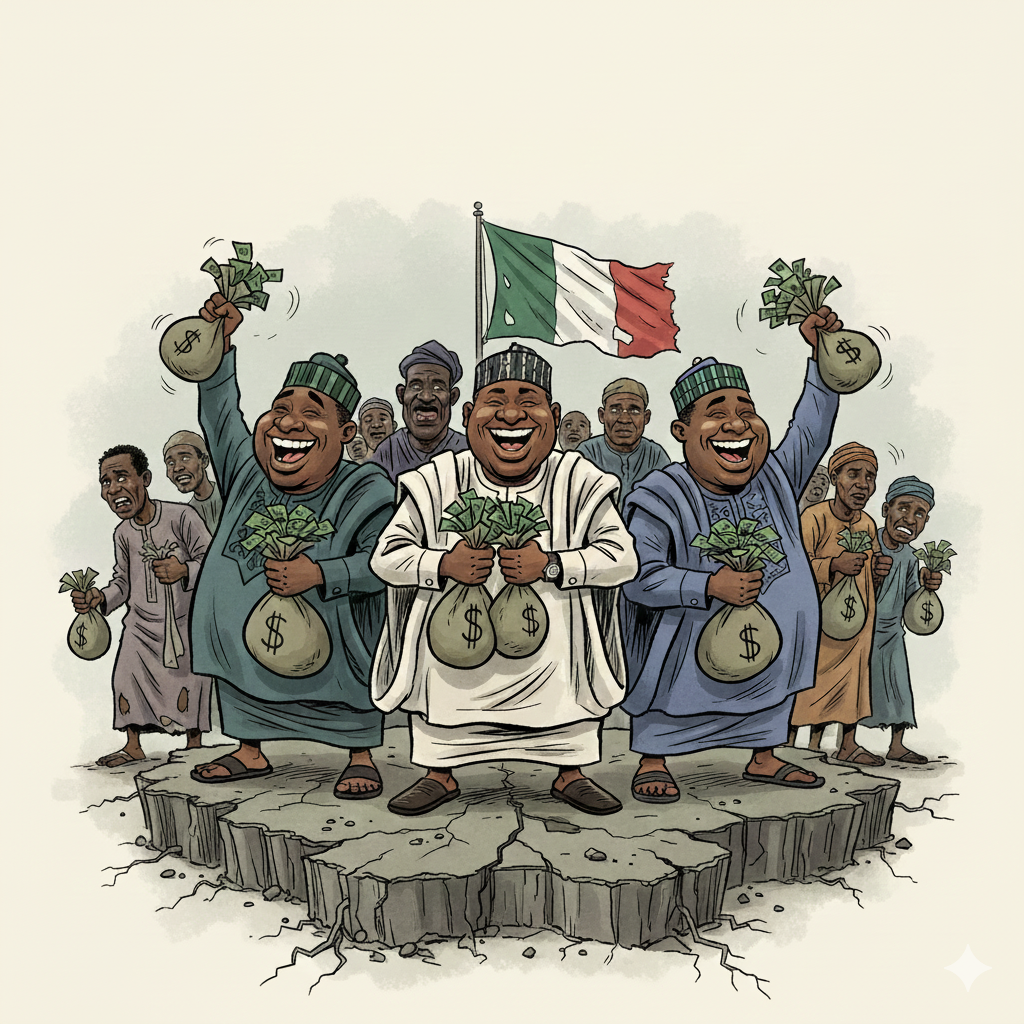
Every nation knows its enemies. Some stand at the borders with guns. Others manipulate markets from abroad. But the deadliest ones are not always the loudest — they are the ones who wear our colours, speak our language, attend our churches and mosques, and pledge loyalty in broad daylight while quietly weakening the very foundations of the country they claim to love. These are the fifth columnists — the enemies within.

HISTORICAL CONTEXT: WHERE THE IDEA CAME FROM

The term “fifth column” was first used during the Spanish Civil War. General Emilio Mola, advancing on Madrid with four columns of troops, boasted that he had a “fifth column” already inside the city — sympathisers whose sabotage, propaganda, and betrayal would weaken Madrid before a single bullet was fired. Since then, the phrase has described people who undermine a nation from within — not with open confrontation, but with quiet collaboration, deceit, and subterfuge. In a modern context, we might add: sometimes, this sabotage is even carried out unknowingly.

NIGERIA’S PRESENT REALITY: A NATION UNDER STRAIN

We are in a moment of deep national vulnerability. Economic hardship is biting. Politicians are having a field day of their own wantonness. Trust in institutions is low. Insecurity remains a dire threat across the length and breadth of the nation. Hope flickers on and off like unstable power supply. Everyone feels the weight, and in such moments, real enemies do not need to invade — they simply need to influence, corrupt, divide, mislead, and sabotage. And this is where the fifth columnists thrive.

THE FIFTH COLUMNISTS IN NIGERIA TODAY

1. THE POLITICAL CLASS — POWER WITHOUT PATRIOTISM

In every nation, politics is supposed to be the arena where ideas compete for the good of the people. In Nigeria, it too often feels like a battlefield where survival, revenge, and self-preservation take precedence over nation-building.

Many in our political class did not come to serve — they came to secure relevance, to guarantee a life of

opulent retirement. They came to fortify networks. They came to protect old loyalties and cultivate new ones. Nigeria becomes secondary. The people become expendable. National interest becomes negotiable. So instead of building the country, they perfect the craft of undermining it. They sabotage reforms the moment those reforms threaten their influence and affluence. They weaponise tribe and religion because a divided country is easier to manipulate. They leak sensitive information — not out of principle, but to weaken whoever is in power or to negotiate their own political escape route. They prefer chaos over accountability, because chaos is profitable. And they treat public office like a dynasty, a birthright, an inheritance — anything but a responsibility.

The tragedy is that this isn’t new. Nigeria’s political class has long known how to manufacture crisis as a political strategy. From the First Republic through the military era and into our present civil rule, scholars and observers have documented the same pattern: crisis is rarely just an “accident”; it is often a tool. Leaders allow tensions to fester, sometimes even stoke them, only to later arrive as “saviours” offering stability on their own terms. Seasoned voices — from public intellectuals to clerics — have warned repeatedly that politicians in Nigeria habitually inflame divisions, not as a last resort, but as a deliberate method of control.

These are not exaggerations; they are lived experiences. Even in recent months, civil society groups have accused political actors of fermenting internal disorder to weaken incumbents and make the country ungovernable. It is one of the oldest tricks in our political playbook: if you cannot win power, destabilise the one who has it. A political class that should be the custodian of stability often becomes the architect of instability. And this is why they belong at the centre of any conversation about the fifth columnists in Nigeria. Because the fifth column is not always made up of foreign agents or shadowy figures.

Sometimes, it is those who sit in parliament by day and conspire in the dark by night. Sometimes, it is those who swear allegiance to Nigeria with one hand raised, while the other hand signs away her future. They are the ones who use our divisions as bargaining chips, who fan the flames of insecurity so that elections can be postponed or opponents weakened, who sabotage reforms so that the rot remains beneficial, who cannot imagine a Nigeria that works because a working Nigeria exposes their emptiness.

These are not “opposition” figures or “ruling party” figures — they exist on all sides. Their loyalty is not to APC or PDP or Labour or any movement. Their loyalty is to power — raw, unfiltered, and self-serving. This is why Nigeria has suffered more from this enemy within than from any threat abroad. Betrayal from inside the house is always more devastating than an attack from outside.

It is so easy to break down and destroy. The heroes are those who make peace and build.
Nelson Mandela

2. THE ECONOMIC SABOTEURS — MERCHANTS OF MISERY

Nigeria’s economic troubles are often discussed as though they are the product of fate or bad luck — global oil shocks, currency weakness, supply chain disruptions, inflationary cycles. But beneath these broad explanations lies a quieter, more uncomfortable truth: a portion of our economic pain is engineered, curated, and sustained by people who understand how to profit from a fragile system.

These saboteurs are not necessarily dramatic figures. They are not insurgents or political arsonists. They are businesspeople, importers, brokers, middlemen, market actors, and institutional insiders who operate in the grey zones where regulation meets opportunity. Their power does not come from ideology. It comes from access, information, relationships, and from an intimate understanding of where the cracks in our economy lie — and how to widen those cracks when necessary. They know how dependent the country is on imported fuel, foreign exchange, staple foods, pharmaceuticals, spare parts, construction materials, and even basic household items. And instead of strengthening these supply lines, they exploit them.

A minor policy announcement can trigger a “scarcity” that did not exist 48 hours earlier. A rumour of price review can empty warehouses overnight. A shift in the exchange rate can become a justification for arbitrarily inflated commodities. Goods that passed through porous borders suddenly flood the market and undercut genuine manufacturers already battling high production costs. And in this same network sit the importers and distributors of fake and substandard products, individuals whose decisions quietly compromise public safety and national competitiveness. The expired drugs, adulterated fuel, counterfeit vehicle parts, substandard electrical cables, weak building materials, and diluted industrial chemicals that circulate in our markets are not accidents; they are the outcome of deliberate choices made by people who have weighed profit against consequence and chosen profit.

Their actions affect everything — from the number of road accidents caused by fake tyres, to the cost of healthcare inflated by counterfeit pharmaceuticals, to the tragedies of building collapses caused by inferior materials. These are not “mistakes” or unfortunate oversights. They are forms of economic behaviour that weaken a nation from the inside. What makes these actors part of the fifth column is not merely the harm they cause, but the fact that they depend on a malfunctioning system to thrive. Stability does not serve them. Efficiency does not serve them. Transparent markets do not serve them. A functional regulatory ecosystem threatens their business model.

So scarcity becomes a tool, distortion becomes strategy, weak enforcement becomes an asset, and the suffering of millions becomes an acceptable cost. This is why a country with refineries cannot keep fuel on its streets. Why a nation with fertile land imports food at levels that make no economic sense. Why even after an appreciating naira, prices remain stubbornly high — because the market is not responding to fundamentals; it is responding to incentives.

Nigeria operates a political economy where some actors benefit when things do not work. And when that happens, national progress becomes an inconvenience. These saboteurs do not need to appear in newspapers or on television. They do not need to threaten government publicly. They simply operate behind closed doors — in ports, in approval offices, in procurement chains, in supply routes, in warehouses, and in networks that have perfected the quiet art of extracting value from dysfunction.

Their weapon is not violence; their weapon is influence, and in many cases, their impact is far more damaging than that of those who carry arms. They form a critical part of the fifth column — the internal actors for whom Nigeria’s fragility is a source of personal stability. Until the incentive structure that empowers them is dismantled, the nation will continue to bleed from wounds inflicted not by external enemies, but by those who operate comfortably within its economic bloodstream.

3. THE SOCIAL SABOTEURS — HOW SOCIETY BECOMES AN UNWITTING ACCOMPLICE

A nation’s strength is not measured only by the competence of its leaders. It is also measured by the attitudes, values, and everyday decisions of its people. And in Nigeria, one of the most uncomfortable truths is that some of the sabotage undermining our progress is not orchestrated by politicians or economic elites alone — it is reinforced by ordinary citizens who mean no real harm, but whose choices slowly weaken the national fabric.

These social saboteurs are not “enemies” in the dramatic sense. They are neighbours, colleagues, influencers, commentators, kinfolk — people who love Nigeria in sentiment, but undermine her in practice. They don’t collapse nations in one big act; they weaken them in a thousand small ways.

a. The Normalisation of Wrongdoing — “Our Own” Syndrome

Nigeria has a long history of excusing corruption or incompetence when it benefits our tribe, our kin, or our political family. We have seen this pattern across decades. When a major financial crime is exposed, reactions split along ethnic and partisan lines. Some condemn the act, others defend the actor, and many retreat into “this is an attack on our people.”

This response pattern is not new.

In the 1970s, during the military era, several probes into public institutions were dismissed in many regions as “political witch-hunts,” even when the evidence was overwhelming. This moral flexibility — this willingness to defend wrongdoing when it favours “our side” — is part of what weakens the national conscience.

It creates an environment where:

                  •  Truth becomes negotiable,

                  •  Accountability becomes selective, and

                  •  Justice becomes a tribal conversation.

A country cannot grow when its citizens defend wrong instead of confronting it.

b. The Social Media Battalions — The New Agents of Confusion

Today, social media has become the largest amplifier of national tension. A rumour from a WhatsApp group can spark panic, a misleading tweet can inflame ethnic tempers, wreck companies, careers, lives and communities, a sensationalised video, often stripped of context, can trend nationwide in hours.

We experienced this during: COVID-19, when false cures circulated faster than official warnings, the cash redesign policy, where misinformation created fear and long queues, multiple election cycles, where unverified “results” and provocative audio clips travelled across the country before INEC could speak, several security incidents, where old videos resurfaced and were misinterpreted as fresh attacks and many more of such. In these moments, many citizens acted as accidental saboteurs — not out of malice, but out of emotion, fear, frustration, or stark ignorance. Yet the result was the same: confusion, division, and the erosion of trust in institutions.

Throughout Nigeria’s history — from the 1966 coup rumours, to the June 12 crisis, to post-2000 ethno-religious tensions — misinformation has played a central role in stoking national anxiety. Social media has simply accelerated a pattern that has always existed: the rapid spread of unverified narratives, often weaponised by those who understand the psychology of a divided society.

c. The Merchants of Division — When Identity Becomes a Tool

Nigeria has always struggled with ethnic and religious rhetoric being used to frame national issues. In the 1940s and 50s, even colonial intelligence reports noted that emerging political leaders were building followership along ethnic lines rather than ideological clarity — often in ways that served colonial interests. That legacy never truly disappeared. Whenever a national debate arises:

                  •  Analysts interpret it through ethnic allegiance,

                  •  Commentators redefine it through religious identity,

                  •  Public figures speak to “their people,” not to the nation.

We saw this play out during controversies around: Resource control, security appointments, protests and agitations, constitutional amendments, even sports and cultural representation.

This habit of segmenting national issues into ethnic grievances slowly erodes unity and strengthens the hands of those who profit from division. It is subtle sabotage — death by a thousand cuts to the very idea of Nigeria.

d. The Culture of Impunity — A Society That Outsources Responsibility

Every time a citizen jumps a queue, evades a duty, pays bribes, throws trash into the gutter, or circumvents due process, a piece of the national system breaks.

We saw this during; fuel scarcity periods, when people with “connections” bypass queues, port congestion, worsened by informal payments, exam registrations where shortcuts are celebrated, building construction where regulations are ignored for speed and cost-saving, passport processing, where “agents” thrive on citizens’ impatience.

These acts seem like survival tactics, but collectively they create an environment where rule of law becomes optional. From the 1980s economic crisis onward, we saw the rise of “alternative systems” to get things done because official systems were too slow or corrupt. Over time, the workaround became the culture, and the culture became a form of self-sabotage.

Why This Matters

To be continued

You Are Not Just Entitled — You Are Responsible

Building the Nigeria We Dream Of Starts With Us

“Ask not what your country can do for you – ask what you can do for your country – John F. Kennedy, 1961

Righteousness exalts a nation, but sin is a reproach to any people.” — Proverbs 14:34

The Illusion of Entitlement

In Nigeria today, a spirit of entitlement has taken root. It’s subtle but widespread—the belief that because we are citizens, we are owed good roads, constant light, safety, healthcare, and justice. And we are. But the truth is this: entitlement without engagement is a deception. Yes, we are entitled to better governance. But expecting national transformation without personal responsibility is like expecting harvest where no seeds were sown. We cannot continue to demand change while refusing to be the change.

You Can’t Microwave a Nation

We often talk about “the system” as if it’s some detached beast. But the system is people. It is you and me. The corruption in high places didn’t fall from the sky—it started with the little compromises in low places. We cheat the queue, pad our invoices, pay for shortcuts, then wonder why Nigeria is broken.

“The price good men pay for indifference to public affairs is to be ruled by evil men.” — Plato

Entitlement makes us wait for miracles from above. But responsibility demands we get involved—in our businesses, offices, schools, and streets. The new Nigeria won’t be served to us on a silver platter. It will be built by deliberate Nigerians.

From Ranting to Rebuilding

It’s easier to rant than to rebuild. That’s why Twitter trends faster than transformer repairs. But what good is a tweet that doesn’t lead to action? What use is a protest that ends in apathy? We cannot keep tearing down without building up. Every curse on Nigeria that isn’t followed by a contribution to its healing is a missed opportunity. Every insult thrown at our leaders that isn’t matched with personal integrity is just noise.
“Do not be overcome by evil, but overcome evil with good.” — Romans 12:21

David vs. Goliath: A Model of National Responsibility

Israel was stuck. Goliath mocked their destiny daily. And though soldiers stood armed and trained, none would move. Until David showed up—not in armor, but in purpose. His power wasn’t in position—it was in responsibility. He didn’t wait for a crown; he carried a cause.
“Is there not a cause?” — 1 Samuel 17:29
David didn’t fight in the name of Judah or for personal glory. He fought for Israel and the name of the Lord. That’s what Nigeria needs: men and women who show up—not because of title, tribe, or trend, but because the nation is worth it.

The Cookie Jar Syndrome: Why Selfishness Is Killing Our Future

Beyond courage, another disease is draining our destiny: selfishness.

The “Cookie Jar Syndrome” is a mindset where every opportunity, deal, or engagement is seen primarily through the lens of personal gain—often to the detriment of the common good. In this mentality, every negotiation, project, or contract becomes a personal cookie jar: What’s in it for me? Short-term profit overrides long-term purpose. Private interest eclipses public good. And because everyone is reaching for their own cookie, the jar eventually empties—leaving behind poverty, distrust, broken systems, and widespread cynicism.

“The moral test of government is how that government treats those who are in the dawn of life, the children; those who are in the twilight of life, the elderly; and those who are in the shadows of life, the sick, the needy and the handicapped.” — Hubert H. Humphrey

If Nigeria must be rebuilt, we must kill the cookie jar mentality. Ask yourself in every deal: Am I serving myself alone, or the greater good? Measure success not just by what you gain, but by what you build.

“A good man leaves an inheritance to his children’s children.” — Proverbs 13:22

Real nation builders aren’t cookie grabbers—they’re cookie bakers. They think: How can I make more for everyone, not just hoard for myself?

Practical Nation Building: What You Can Do Today

Let’s stop asking “Who will fix Nigeria?” and start asking, “What can I fix?” Because true national change starts with personal responsibility. It’s not about grand speeches or high office. It’s about ordinary people doing the extraordinary with what they have—where they are.

1. Excel in Your Assignment: Be a Model of Diligence
Whether you’re a teacher, tailor, techpreneur, trader, banker, or barber—do your work with integrity and excellence. Every job in Nigeria matters. Every assignment is a platform for transformation. When you deliver with consistency, fairness, and skill, you elevate standards.
Imagine a Nigeria where public servants don’t demand bribes, where artisans don’t cut corners, where professionals keep time, and contracts are honored without excuses. That’s not wishful thinking—it starts with you. Let excellence be your protest. Let diligence be your demonstration. Don’t just complain about the rot—be the reform.

2. Engage, Don’t Just Outrage: Call Your Reps. Send Feedback. Show Up
It’s not enough to vent on social media. The real work is in engaging the system with clarity and purpose. Nigeria’s democracy may be flawed, but it is still a system that can be influenced. Know your local government chairman, your House of Reps member, your senator. Write letters, emails, and petitions. Tag them publicly and privately. Join public hearings or town halls when they’re called. If they’re not, demand one. Support citizens and organizations that are monitoring budgets and demanding transparency. Ranting is reactive. Engagement is proactive.

3. Partner for Local Impact: Start Something. Invite Others
You don’t need to wait for the presidency to fix your neighborhood. Start small. Co-fund a borehole with your neighbors. Clean up the market with your youth group. Organize a food bank, library, or free lesson for kids in your area. Start a WhatsApp group to monitor local council projects. Use your church or mosque platform for civic education. The power of collaboration is that it multiplies influence. Where one person can reach ten, ten people can transform a community. The most powerful movements in history started small—with people who cared enough to act.

4. Raise Citizens, Not Cynics: Train Your Children in Values
One of the greatest tragedies in Nigeria is the normalization of dysfunction. Many children grow up learning how to “hustle” the system instead of fix it. That cycle must break—with you. Teach them honesty, responsibility, and empathy. Tell them stories of Nigerian heroes—not just of war, but of reform. Expose them to books, debates, and platforms that stretch their civic minds. Let them see you live with conviction, not convenience. Children don’t become nation builders by accident. They’re formed by intentional parents, mentors, and communities.

5. Live Like a Light: Let People See in Your Life What They Wish the Country Was
Be the Nigeria you dream of. Let your words and actions reflect the integrity, love, order, and honor that we want to see in our leaders. Don’t take bribes—or offer them. Keep promises. Respect time. Respect people, even when you disagree. Be the same person in public and in private.
“You are the light of the world. A city set on a hill cannot be hidden.” — Matthew 5:14
Let your life be a protest sign. Let it be a roadmap. Let it be evidence that Nigeria can work—because in your corner, it already does.

Voices Worth Emulating: From History to Now

In every generation, there are men and women who rise above apathy to shape nations. Nigeria’s story—though fraught with struggle—has always had builders worth learning from.
Historic Statesmen & Builders:
– Chief Obafemi Awolowo – Premier of the Western Region, visionary in education and infrastructure. “The children of the poor you fail to train will never let your children have peace.”
– Dr. Nnamdi Azikiwe – First President of Nigeria. “The realization of human interdependence and unity in diversity must be the base of our political ideology.”
– Sir Ahmadu Bello – Sardauna of Sokoto, moral and administrative leader. “The mistake of 1914 has come to stay.”
– Tafawa Balewa – First Prime Minister, known for humility and diplomacy. “We must stand united before the world.”

Final Word: A Nation Is Not Given. It Is Made.

“Blessed is the nation whose God is the Lord.” — Psalm 33:12

We cannot continue expecting without investing. A new Nigeria will not be delivered through bitterness, hashtags, or silence. It will come through deliberate men and women—builders, not complainers. Reformers, not spectators. People who refuse to fold their arms while Goliath mocks their destiny.
“Nigeria is not just ours to inherit. It is ours to build.”
So rise. In your field. In your family. In your faith.
Because you are not just entitled to a better Nigeria—You are responsible for making it happen.


Sagamu-Benin Expressway: A Dangerous Path for Drivers

Remember that childhood game of “Snakes and Ladders”? Sadly, the Sagamu-Benin Expressway in Ogun State feels more like a perpetual descent down a rickety, pothole-ridden chute than a smooth climb toward progress. On a recent trip to Epe, I had to pass through this expressway, and it was a horrifying experience. The state of the road, coupled with the terrible traffic, made it a journey I wouldn’t wish to undertake again any time soon. This critical artery, connecting the economic powerhouse of Lagos to the heart of the South-South region, has become a motorist’s nightmare, a national Continue reading

The Rehoboam Menace of Leadership in Nation Building

3-4 Rehoboam assembled Jeroboam and all the people. They said to Rehoboam, “Your father made life hard for us—worked our fingers to the bone. Give us a break; lighten up on us and we’ll willingly serve you.”
5 “Give me three days to think it over, then come back,” Rehoboam said.
6 King Rehoboam talked it over with the elders who had advised his father when he was alive: “What’s your counsel? How do you suggest that I answer the people?”

Continue reading

The Era of Trust and Integrity

Finally, 2016 has commenced officially world over. And we all have our goals set for the year, and our aspirations for the country and our personal lives. Nonetheless, i would like to start by referring to the events in the country in the last couple of weeks that has left much of a bitter taste in the mouth. And whether we like it or not, we need to evaluate the past to learn and make amends for the future.

Continue reading