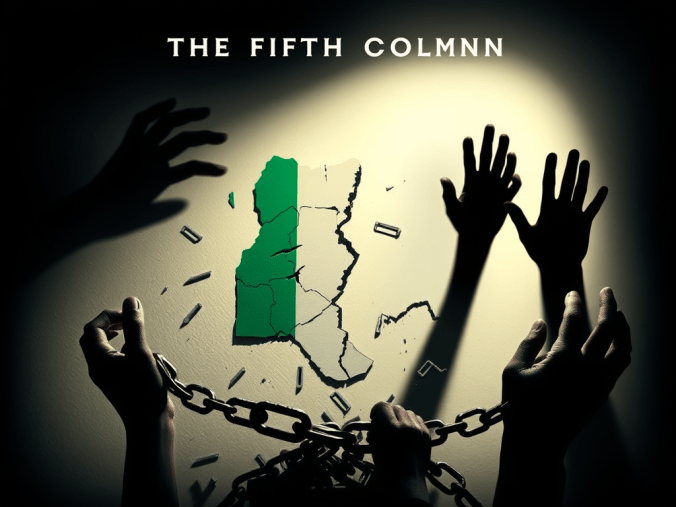
THE FIFTH COLUMN: How Nigeria’s Greatest Threat Comes From Within – Part 2

To catch up on Part 1

Why This Matters

A nation is the sum of its citizens.

When citizens normalize shortcuts, defend wrongdoing, celebrate false assertions, inflame divisions, or spread unverifiable information, they inadvertently strengthen the hands of those who deliberately undermine the nation. This is why the social saboteur is still part of the fifth column — not just the ones acting innocently, but also those who do it deliberately. Some citizens amplify misinformation, distort narratives, or stoke tensions not out of ignorance, but because outrage brings engagement. Views bring money. Sensationalism brings followers. And in today’s digital economy, trending has become a business model.

They know exactly what they are doing.

They know fear spreads faster than facts.

They know division generates more clicks than unity.

For them, national stability is a distant concern; virality is the goal.

So at the social level, the fifth column sits on a spectrum:

  • the genuinely misled,
  • the emotionally reactive,
  • the weary and disillusioned,
  • the social media influencers and wannabe activists chasing relevance,
  • and the fully conscious actors who weaponize outrage and misinformation for profit, engagement and virality.

And this is the painful truth: the collapse of nations is rarely caused by one great betrayal; more often, it is caused by millions of small compromises, some innocent, many intentional. Until we confront this truth, we will keep fighting external battles while the internal ones continue to multiply in broad daylight.

“The single biggest threat to our democracy is the notion that we don’t have to believe in facts.”
Barack Obama 

4. THE BUREAUCRATIC GATEKEEPERS — KILLERS OF POLICY AND PROGRESS

Every nation has its political class and its business elite, but there is a third layer that quietly determines whether a country works or fails, the bureaucracy. In Nigeria, this layer is often overlooked, yet it is one of the most powerful internal forces shaping national outcomes.

Here lie the people who do not run for office, do not appear at political rallies, do not court public attention, but who hold the levers that determine whether policies live or die. These bureaucratic gatekeepers are the custodians of files, processes, approvals, permissions, data, and institutional memory. And because they sit deep inside the engine room of government, their influence is rarely challenged and often underestimated. Their sabotage does not come through protests or open confrontation.

  • It comes through delays.
  • Through silence.
  • Through procedural ambush.
  • Through selective interpretation of policy.
  • Through “missing” documents that suddenly reappear after the price is right.
  • Through committees that never meet.
  • Through memos that “did not reach the table.”
  • They have mastered the art of slowing down progress until it suffocates.

We have seen this pattern repeatedly in Nigeria’s history.

During the post-oil boom reforms of the early 1980s, many of the modernisation efforts championed by technocrats were quietly frustrated by bureaucrats who feared losing control over existing systems. Records were withheld, processes disrupted, and key agencies resisted changes that threatened entrenched interests.

During the banking consolidation reforms of the mid-2000s, insiders repeatedly noted that some of the strongest resistance did not come from the banks themselves, but from within parts of the bureaucracy responsible for implementing the reforms. For many career civil-service actors, greater transparency and simplified oversight meant fewer opportunities for discretion, influence, and rent-seeking. As several analysts observed at the time, the challenge was not only technical, it was cultural and institutional.

Even today, across ministries and agencies, many well-intentioned reforms fail not because they lack political backing, but because mid-level and senior bureaucrats ensure they never fully take off. A contractor who refuses to “cooperate” suddenly discovers that his file has gone missing. A reform-minded appointee finds themselves stonewalled by staff who were in those offices before them, and who will remain long after they leave. Procurement becomes more complicated when transparency threatens established networks. Digital reforms struggle when manual processes are more profitable for those who control them.

This is not incompetence. It is a system of quiet self-preservation.

These actors operate beneath the political radar but influence everything from budget releases to project planning, licensing, customs clearance, recruitment, and regulatory enforcement. They know the bottlenecks because they built them. They know how to stall progress without ever appearing rebellious. They protect old structures because those structures protect them. In a sense, the bureaucracy becomes a nation within a nation, insulated from elections, public opinion, and, too often, accountability.

And this is what makes them part of the fifth column. Not because they are ideological enemies of Nigeria, but because they defend a system that slows down the country’s development. They are the custodians of the status quo — and the status quo is dysfunction. A visionary leader may come into office. A strong policy may be written. A budget may be approved. A reform may be announced with fanfare. Yet everything grinds to a halt in the hands of bureaucrats who have perfected one subtle but deadly skill: blocking progress without leaving fingerprints. They do not shout. They do not fight. They simply ensure things do not move.

It is difficult to build a nation when those who hold the administrative machinery are invested in keeping things exactly as they are. Until this layer is reformed, protected, and modernised, Nigeria will continue to drag its feet — not because of a lack of ideas, but because of an internal machinery designed to frustrate execution.

5. THE ROLE OF FOREIGN POWERS — BUT NOT WITHOUT INTERNAL ALLIES

It is tempting to place the weight of Nigeria’s troubles on foreign governments. But the truth is more complex. Nations, especially powerful ones, do not operate on morality. They operate on interest. They protect their strategic corridors, their economic leverage, their ideological reach. That is the real currency of geopolitics. The deeper danger lies elsewhere: in the local actors who willingly open the gates.

Foreign interference only becomes effective when internal collaborators, political actors, lobbyists, civil society influencers, social media influencers, wannabe activists, and even security insiders, create the cracks through which external influence flows. History is clear on this point: no nation collapses purely from external assault. Collapse begins from within. Weak institutions, fragmented societies, compromised leaders, and citizens who become foot soldiers for agendas they do not fully understand — these are the true entry points.

This is not theory. This is history.

Across Africa, Asia, Latin America and the Middle East, we have watched powerful nations, the United States, France, Britain, Russia and others, quietly shape political outcomes in countries that refused to align with their interests, often under noble labels: “democracy promotion,” “counter-terrorism,” “protecting minorities,” “defending human rights.” From coups engineered during the Cold War, to destabilisation efforts masked as “support for civil society,” to covert alliances with rebel groups and armed factions, the playbook is well-established.

Nigeria is not exempt.

The Trump Threat — Compassion Wrapped Around a Loaded Gun

In November 2025, the U.S. President Donald Trump announced that he had ordered the Pentagon to prepare “options” for possible military action in Nigeria, citing an alleged “Christian genocide” and an “existential threat” to Christianity in our country. He coupled this with threats to cut off U.S. aid if Nigeria did not act the way Washington wanted. On paper, it sounded like a moral crusade: defend persecuted Christians; punish those who ignore their suffering.

In reality, the picture is more complicated.

Data from independent conflict monitors and reporting by global media have repeatedly shown that while Christians have suffered brutal violence in Nigeria, Muslims and other groups have also been killed in large numbers, especially in the northeast where Boko Haram and ISWAP have wiped out entire Muslim communities. The African Union, Nigerian officials, and several analysts have publicly rejected the “genocide” label as inaccurate, warning that this kind of simplification does more to inflame tensions than to solve them. Nigerians have not been silent either. Protests broke out in places like Kano with placards reading “There is no Christian genocide in Nigeria” and “America wants to control our resources,” rejecting both the label and the coercive tone of the threat.

Yet, instead of nuance, the world got a soundbite: “Christianity is facing an existential threat in Nigeria. We may have to go in.”

In Washington, some lawmakers eagerly lined up behind this framing. A resolution was introduced in the U.S. Congress that not only condemned the persecution of Christians in Nigeria, but also explicitly declared readiness to “support President Donald J. Trump in taking decisive action”, language that many Nigerians read as political cover for some form of intervention. To many of us watching from here, it felt less like sober diplomacy and more like theatre: our trauma turned into talking points, our complexity reduced to a neat narrative that fits a domestic political script.

The Nicki Minaj Moment — When Celebrity Platforms Carry Lopsided Stories

Into this already charged atmosphere stepped an unlikely actor: Nicki Minaj. In November 2025, the American rapper addressed a United Nations event, speaking emotionally about what she described as “Christians being targeted” in Nigeria, churches burned, families displaced, communities living in fear. She thanked Trump for “prioritizing the issue” and used her huge platform to demand urgent action. On one level, her empathy is genuine and admirable. It is true that Christians in Nigeria have suffered massacres, kidnappings, church burning and terror attacks. Those lives matter. Their pain is not imaginary. But again, what was missing was the rest of the story.

The same conflict data and human-rights reports that document attacks on Christians also show that Muslims have been killed in even greater numbers in some regions, and that much of the violence is driven by a toxic mix of jihadist insurgency, banditry, land disputes, failed governance and criminal opportunism, not a single, neat campaign of one religion exterminating the other. Yet the global clip that trended was simple: “In Nigeria, Christians are being targeted.” Full stop.

To make matters worse, Nigerian officials were reportedly barred from the room during that UN event at the specific request of the organisers and their U.S. hosts, a move that fed the perception here that our country was being tried and sentenced in absentia. This is how modern fifth-column dynamics work in a globalized world:

  • Local actors feed selective or exaggerated narratives to foreign lawmakers, lobby groups and faith networks.
  • Those groups frame Nigeria to their audiences as a simple morality tale: righteous victims, evil persecutors, cowardly government.
  • Politicians and celebrities, some genuinely moved, others clearly responding to well-organized lobbying, amplify the story on platforms like Congress, the UN and cable news.
  • Before long, a foreign president is threatening to send troops “guns-a-blazing,” and our complex security crisis is reduced to a campaign slogan.

A UN podium carries moral weight. A viral celebrity clip carries emotional weight. A congressional resolution carries diplomatic weight. When all three are built on a partial picture, truth struggles to breathe. The real tragedy is that while these narratives trend, many of the actual victims of Nigeria’s violence, Muslim communities erased in the northeast, Christians attacked in largely Christian southeast states, farmers and herders killed in reprisal cycles in the Middle Belt, become invisible if they don’t fit the script. Once again, the point is not to deny suffering. The point is to insist that our story will not be told for us, around us, and against us.

Foreign Powers, Local Mouthpieces

Foreign powers have always behaved like foreign powers. That is not new. The tragedy is when citizens become the mouthpieces of external ambitions, knowingly or unknowingly. Some internal actors:

  • feed foreign agencies distorted data,
  • exaggerate local conflicts to attract funding or asylum,
  • curate “genocide” language for Western ears while downplaying the suffering of groups that do not fit their chosen narrative,
  • lobby against their own country in foreign capitals because personal victory matters more than collective peace.

Foreign politicians and influencers, while sometimes sincerely moved, are not neutral. Some are clearly being courted and lobbied to press a particular line, as we have seen with prominent U.S. legislators pushing “Christian genocide” resolutions and publicly cheering Trump’s threats of military action.

This is what fifth-column activity looks like in the age of soft power: not just bombs and spies, but reports, hearings, think-tank papers, NGO briefings, faith-based lobbying, celebrity speeches and emotionally charged narratives tailored for Western consumption.

Nigeria must be alert.

In a world where narratives move faster than facts, misinformation is the new weapon of intervention , and influencers, lawmakers and even pastors can become instruments of a fifth column that begins inside our borders.

To be continued

INTOXICATION OF POWER

Vladimir Putin, the Russian President made a statement this week during a visit from the French President, Emmanuel Macron. He outrightly made clear his stance on Ukraine joining NATO and what the implications would be for the entire world. He stated, “Russia’s weapons are quite incomparable to that of NATO” but warned his country is still ‘one of the leading nuclear states’. “You don’t want war…neither do I…for there will be no winners, and you will be pulled into this conflict against your will…”

Vladimir Putin needs no formal introduction, and the Ukraine crisis needs no elaborate briefings to bring you up to speed. If you have been monitoring international news it would not come out strange to you. That aside, United States is warning its citizens to evacuate Ukraine as an attack by Russia is imminent within a couple of hours and several European countries are making the same declaration. But what gives Russia these guts to make a bold stand and willing to confront the world?

Russia is a superpower in her own rights. And under a leader with balls of steel and sheer cunning, you can imagine how frightful that prospect is. The Cold War era was majorly a war between the West led by USA and her allies, and the Eastern Bloc led by USSR (now Russia) and her allies, and which ended 3rd Dec 1989 with the fall of the Berlin Wall.  The Cold War was a decade of intrigues, espionage, counter espionage, sober rattling, near war misses, massive research and development in weapons and arms which led to nuclear stockpiling on both sides and other frightful weapons of mass destruction, and diplomatic horse shoeing across the globe.

Now won’t you wonder that all these countries were once allies against Germany in WW1 and WW2? What has led to a turn of events with allies now turning to enemies and vice versa?

The answer lies in ‘power’. The desire to dominate and be in control…a personal ambition of one man and nation.

For historical perspective, Ukraine used to be under the USSR until the dissolution of that republic and Ukraine gained her independence in Aug 24, 1991. However, political intrigues in 2013 led to unrest and Pro-Russia elements declaring independence and making room for Russian annexation of Crimea in 2014. Despite international outcry, and the unfortunate incident of the downing of an airplane, Russia never budged, and they are back on the borders of Ukraine, to grab more. Does this not sound like when Germany invaded Poland that led to the start of WW2? History is repeating itself is it not?

Now, the West and the East are on double alert mode waiting for the first move as in a game of chess…and both sides awfully aware of the casualties that would occur. This is 2022, not 1939, one party as already declared he is willing to lose to make a point…in other words, more than willing to sacrifice the world to make his stand clear…and with the armament on ground, people would be dead before they can even realise what hit them…probably worse than Nagasaki and Hiroshima.

How concerned should Africa be?

Well, unlike WW1 and WW2 when Africans were conscripted into the army and shipped to the battlefront, it won’t be so this time around. But we would feel the effects of the war should it start. How you ask? I am in Africa…not near the theatre of war…well true, but it’s a self-delusion.

  1. Should nuclear or other non-conventional weapons be used, we would feel the aftermath of the effects in Africa carried by wind currents and by whatever mode of transport. Remember, COVID-19.
  2. World economy would be paralysed. Yes, you read right. Nobody wants to be a casualty of war; everyone wants to be within their safe zone. US did not initially join the WW2 until invasion by Japan at Pearl Harbour. What makes you think, to widen the scope of the war, unprovoked invasion or attacks will not occur? Remember, Putin already said, you will all be drawn into it against your will…
  3. We are not prepared to even take care of ourselves as individual African countries in times of relative peace not to talk of when there is a war ravaging Europe. We are heavily dependent on foreign aids and Europe; America and China are our biggest market. If China does not get dragged into the war…there might still be hope but China is a like a dozing bully…who can wake up and strike at any time…so really…where do, we hope in?

Africans need to be self-reliant and break the shackles of colonial mentality that has bedevilled us since we have achieved our respective independence. We have the resources and the manpower…let’s put our brain to work and develop and not rely on stipends.

Aside that, the big bullies need to call themselves for a seat down and hold a frank talk. I am sure that is been done and is on-going, but to start the war…with a lose-lose mindset…is already debilitating as it is and shows the selfishness of power and self-aggrandisement. The earlier the citizens of NATO and Russia speak some home truth to their leaders the better for the whole world to avoid bloodshed and untold hardship.

It is clear, that UN can no longer be the watchdog in the world, the arbiter for peace…and it is high time for nations to acknowledge where true sovereignty lies and bow in worship.  Micah 4:1-4 AMP captures it succinctly,

“But it shall come about in the last days
That the mountain of the house of the Lord
Shall be established as the highest and chief of the mountains;
It shall be above the hills,
And peoples shall flow [like a river] to it.


And many nations shall come and say,
“Come, let us go up to the mountain of the Lord,
To the house of the God of Jacob,
That He may teach us about His ways
And that we may walk in His paths.”
For the law shall go forward from Zion,
And the word of the Lord [the revelation about Him and His truth] from Jerusalem.


And He will judge between many peoples
And render decisions for strong and distant nations.
Then they shall hammer their swords into plowshares
And their spears into pruning hooks [so that the implements of war may become the tools of agriculture];
Nation shall not lift up sword against nation,
Nor shall they ever again train for war.


Each of them shall sit [in security and peace] under his vine
And under his fig tree,
With no one to make them afraid,
For the mouth of the [omnipotent] Lord of hosts has spoken it.”

I Thought The Whites Owned South Africa! II

While its on record of the Anglo-Boer war of the 19th Century and prelude to that, the revolt to the Dutch Republic and the establishment of a separate republic in the Southern Africa, its worthy to note that the discovery of diamonds in 1867 and gold in 1884 in the interior started the Mineral Revolution and increased economic growth and immigration. This intensified the European-South African efforts to gain control over the indigenous peoples. The struggle to control these important economic resources was a factor in relations between Europeans and the indigenous population and also between the Boers and the British. This utmostly defined the relationship between all the parties concerned and began the process of establishing independence and the creation of Union of South Africa on 31 May 1910. Continue reading

Thought The Whites Owned South Africa!

In the last couple of weeks especially last week, the social media was awashed with news from South Africa, of white folks in South Africa calling Black folks monkeys and claiming Blacks were let into South Africa and they are trying to take over everywhere or that it was the white folks that owned South Africa.

Am really not surprised by this, going by the events occurring in United States of Blacks been killed extra judicially by people who are meant to protect the people, the Police, and the start of the movement #Black lives Matter.

Continue reading

OBITUARY

AN OBITUARY PRINTED IN THE LONDON TIMES

Today we mourn the passing of a beloved old friend, Common Sense, who has been with us for many years. No one knows for sure how old he was, since his birth records were long ago lost in bureaucratic red tape. He will be remembered as having cultivated such valuable lessons as knowing when to come in out of the rain, why the early bird gets the worm, life isn’t always fair and maybe it was my fault. 

Common Sense lived by simple, sound financial policies (don’t spend more than you can earn) and reliable strategies (adults, not children, are in charge). Continue reading
