THE FIFTH COLUMN: How Nigeria’s Greatest Threat Comes From Within

Part 1

Every nation knows its enemies. Some stand at the borders with guns. Others manipulate markets from abroad. But the deadliest ones are not always the loudest — they are the ones who wear our colours, speak our language, attend our churches and mosques, and pledge loyalty in broad daylight while quietly weakening the very foundations of the country they claim to love. These are the fifth columnists — the enemies within.

HISTORICAL CONTEXT: WHERE THE IDEA CAME FROM

The term “fifth column” was first used during the Spanish Civil War. General Emilio Mola, advancing on Madrid with four columns of troops, boasted that he had a “fifth column” already inside the city — sympathisers whose sabotage, propaganda, and betrayal would weaken Madrid before a single bullet was fired. Since then, the phrase has described people who undermine a nation from within — not with open confrontation, but with quiet collaboration, deceit, and subterfuge. In a modern context, we might add: sometimes, this sabotage is even carried out unknowingly.

NIGERIA’S PRESENT REALITY: A NATION UNDER STRAIN

We are in a moment of deep national vulnerability. Economic hardship is biting. Politicians are having a field day of their own wantonness. Trust in institutions is low. Insecurity remains a dire threat across the length and breadth of the nation. Hope flickers on and off like unstable power supply. Everyone feels the weight, and in such moments, real enemies do not need to invade — they simply need to influence, corrupt, divide, mislead, and sabotage. And this is where the fifth columnists thrive.

THE FIFTH COLUMNISTS IN NIGERIA TODAY

1. THE POLITICAL CLASS — POWER WITHOUT PATRIOTISM

In every nation, politics is supposed to be the arena where ideas compete for the good of the people. In Nigeria, it too often feels like a battlefield where survival, revenge, and self-preservation take precedence over nation-building.

Many in our political class did not come to serve — they came to secure relevance, to guarantee a life of
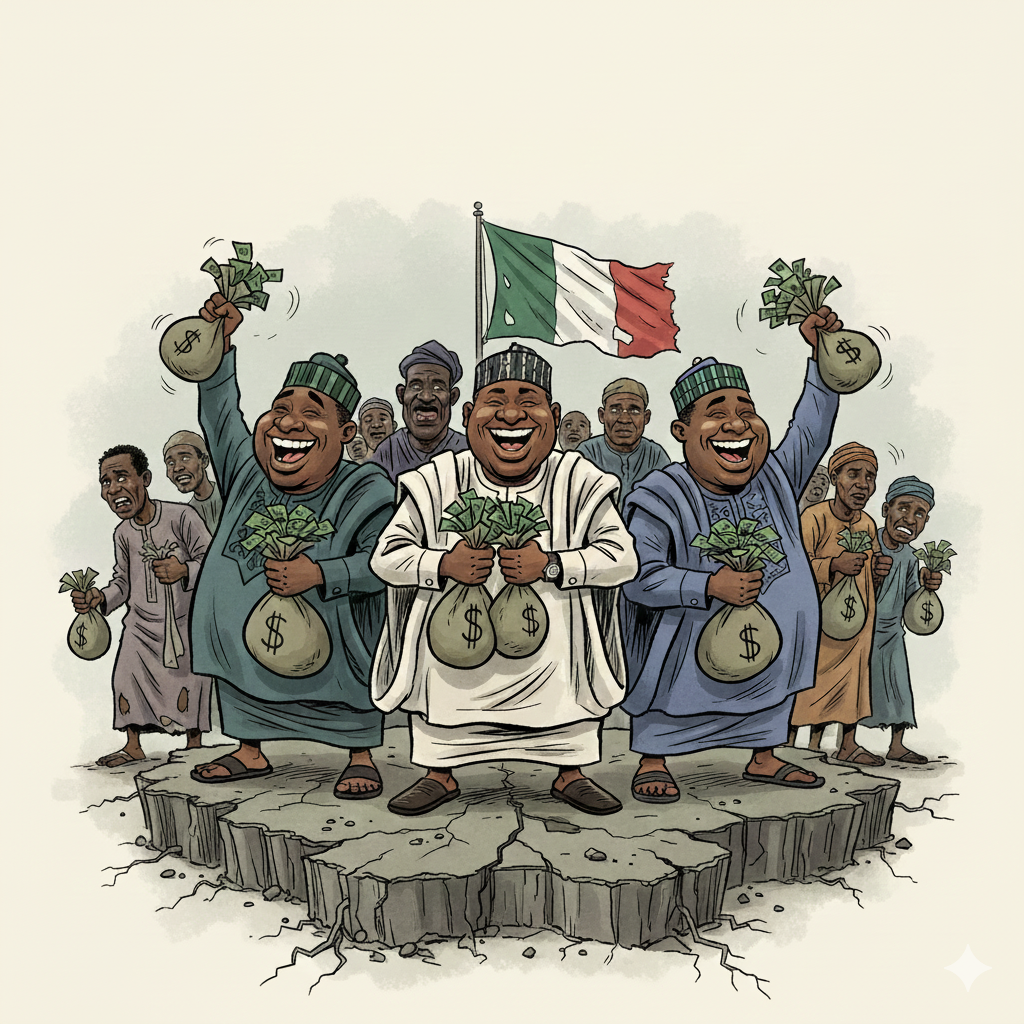
opulent retirement. They came to fortify networks. They came to protect old loyalties and cultivate new ones. Nigeria becomes secondary. The people become expendable. National interest becomes negotiable. So instead of building the country, they perfect the craft of undermining it. They sabotage reforms the moment those reforms threaten their influence and affluence. They weaponise tribe and religion because a divided country is easier to manipulate. They leak sensitive information — not out of principle, but to weaken whoever is in power or to negotiate their own political escape route. They prefer chaos over accountability, because chaos is profitable. And they treat public office like a dynasty, a birthright, an inheritance — anything but a responsibility.

The tragedy is that this isn’t new. Nigeria’s political class has long known how to manufacture crisis as a political strategy. From the First Republic through the military era and into our present civil rule, scholars and observers have documented the same pattern: crisis is rarely just an “accident”; it is often a tool. Leaders allow tensions to fester, sometimes even stoke them, only to later arrive as “saviours” offering stability on their own terms. Seasoned voices — from public intellectuals to clerics — have warned repeatedly that politicians in Nigeria habitually inflame divisions, not as a last resort, but as a deliberate method of control.

These are not exaggerations; they are lived experiences. Even in recent months, civil society groups have accused political actors of fermenting internal disorder to weaken incumbents and make the country ungovernable. It is one of the oldest tricks in our political playbook: if you cannot win power, destabilise the one who has it. A political class that should be the custodian of stability often becomes the architect of instability. And this is why they belong at the centre of any conversation about the fifth columnists in Nigeria. Because the fifth column is not always made up of foreign agents or shadowy figures.

Sometimes, it is those who sit in parliament by day and conspire in the dark by night. Sometimes, it is those who swear allegiance to Nigeria with one hand raised, while the other hand signs away her future. They are the ones who use our divisions as bargaining chips, who fan the flames of insecurity so that elections can be postponed or opponents weakened, who sabotage reforms so that the rot remains beneficial, who cannot imagine a Nigeria that works because a working Nigeria exposes their emptiness.

These are not “opposition” figures or “ruling party” figures — they exist on all sides. Their loyalty is not to APC or PDP or Labour or any movement. Their loyalty is to power — raw, unfiltered, and self-serving. This is why Nigeria has suffered more from this enemy within than from any threat abroad. Betrayal from inside the house is always more devastating than an attack from outside.

It is so easy to break down and destroy. The heroes are those who make peace and build.
Nelson Mandela

2. THE ECONOMIC SABOTEURS — MERCHANTS OF MISERY

Nigeria’s economic troubles are often discussed as though they are the product of fate or bad luck — global oil shocks, currency weakness, supply chain disruptions, inflationary cycles. But beneath these broad explanations lies a quieter, more uncomfortable truth: a portion of our economic pain is engineered, curated, and sustained by people who understand how to profit from a fragile system.

These saboteurs are not necessarily dramatic figures. They are not insurgents or political arsonists. They are businesspeople, importers, brokers, middlemen, market actors, and institutional insiders who operate in the grey zones where regulation meets opportunity. Their power does not come from ideology. It comes from access, information, relationships, and from an intimate understanding of where the cracks in our economy lie — and how to widen those cracks when necessary. They know how dependent the country is on imported fuel, foreign exchange, staple foods, pharmaceuticals, spare parts, construction materials, and even basic household items. And instead of strengthening these supply lines, they exploit them.

A minor policy announcement can trigger a “scarcity” that did not exist 48 hours earlier. A rumour of price review can empty warehouses overnight. A shift in the exchange rate can become a justification for arbitrarily inflated commodities. Goods that passed through porous borders suddenly flood the market and undercut genuine manufacturers already battling high production costs. And in this same network sit the importers and distributors of fake and substandard products, individuals whose decisions quietly compromise public safety and national competitiveness. The expired drugs, adulterated fuel, counterfeit vehicle parts, substandard electrical cables, weak building materials, and diluted industrial chemicals that circulate in our markets are not accidents; they are the outcome of deliberate choices made by people who have weighed profit against consequence and chosen profit.

Their actions affect everything — from the number of road accidents caused by fake tyres, to the cost of healthcare inflated by counterfeit pharmaceuticals, to the tragedies of building collapses caused by inferior materials. These are not “mistakes” or unfortunate oversights. They are forms of economic behaviour that weaken a nation from the inside. What makes these actors part of the fifth column is not merely the harm they cause, but the fact that they depend on a malfunctioning system to thrive. Stability does not serve them. Efficiency does not serve them. Transparent markets do not serve them. A functional regulatory ecosystem threatens their business model.

So scarcity becomes a tool, distortion becomes strategy, weak enforcement becomes an asset, and the suffering of millions becomes an acceptable cost. This is why a country with refineries cannot keep fuel on its streets. Why a nation with fertile land imports food at levels that make no economic sense. Why even after an appreciating naira, prices remain stubbornly high — because the market is not responding to fundamentals; it is responding to incentives.

Nigeria operates a political economy where some actors benefit when things do not work. And when that happens, national progress becomes an inconvenience. These saboteurs do not need to appear in newspapers or on television. They do not need to threaten government publicly. They simply operate behind closed doors — in ports, in approval offices, in procurement chains, in supply routes, in warehouses, and in networks that have perfected the quiet art of extracting value from dysfunction.

Their weapon is not violence; their weapon is influence, and in many cases, their impact is far more damaging than that of those who carry arms. They form a critical part of the fifth column — the internal actors for whom Nigeria’s fragility is a source of personal stability. Until the incentive structure that empowers them is dismantled, the nation will continue to bleed from wounds inflicted not by external enemies, but by those who operate comfortably within its economic bloodstream.

3. THE SOCIAL SABOTEURS — HOW SOCIETY BECOMES AN UNWITTING ACCOMPLICE

A nation’s strength is not measured only by the competence of its leaders. It is also measured by the attitudes, values, and everyday decisions of its people. And in Nigeria, one of the most uncomfortable truths is that some of the sabotage undermining our progress is not orchestrated by politicians or economic elites alone — it is reinforced by ordinary citizens who mean no real harm, but whose choices slowly weaken the national fabric.

These social saboteurs are not “enemies” in the dramatic sense. They are neighbours, colleagues, influencers, commentators, kinfolk — people who love Nigeria in sentiment, but undermine her in practice. They don’t collapse nations in one big act; they weaken them in a thousand small ways.

a. The Normalisation of Wrongdoing — “Our Own” Syndrome

Nigeria has a long history of excusing corruption or incompetence when it benefits our tribe, our kin, or our political family. We have seen this pattern across decades. When a major financial crime is exposed, reactions split along ethnic and partisan lines. Some condemn the act, others defend the actor, and many retreat into “this is an attack on our people.”

This response pattern is not new.

In the 1970s, during the military era, several probes into public institutions were dismissed in many regions as “political witch-hunts,” even when the evidence was overwhelming. This moral flexibility — this willingness to defend wrongdoing when it favours “our side” — is part of what weakens the national conscience.

It creates an environment where:

                  •  Truth becomes negotiable,

                  •  Accountability becomes selective, and

                  •  Justice becomes a tribal conversation.

A country cannot grow when its citizens defend wrong instead of confronting it.

b. The Social Media Battalions — The New Agents of Confusion

Today, social media has become the largest amplifier of national tension. A rumour from a WhatsApp group can spark panic, a misleading tweet can inflame ethnic tempers, wreck companies, careers, lives and communities, a sensationalised video, often stripped of context, can trend nationwide in hours.

We experienced this during: COVID-19, when false cures circulated faster than official warnings, the cash redesign policy, where misinformation created fear and long queues, multiple election cycles, where unverified “results” and provocative audio clips travelled across the country before INEC could speak, several security incidents, where old videos resurfaced and were misinterpreted as fresh attacks and many more of such. In these moments, many citizens acted as accidental saboteurs — not out of malice, but out of emotion, fear, frustration, or stark ignorance. Yet the result was the same: confusion, division, and the erosion of trust in institutions.

Throughout Nigeria’s history — from the 1966 coup rumours, to the June 12 crisis, to post-2000 ethno-religious tensions — misinformation has played a central role in stoking national anxiety. Social media has simply accelerated a pattern that has always existed: the rapid spread of unverified narratives, often weaponised by those who understand the psychology of a divided society.

c. The Merchants of Division — When Identity Becomes a Tool

Nigeria has always struggled with ethnic and religious rhetoric being used to frame national issues. In the 1940s and 50s, even colonial intelligence reports noted that emerging political leaders were building followership along ethnic lines rather than ideological clarity — often in ways that served colonial interests. That legacy never truly disappeared. Whenever a national debate arises:

                  •  Analysts interpret it through ethnic allegiance,

                  •  Commentators redefine it through religious identity,

                  •  Public figures speak to “their people,” not to the nation.

We saw this play out during controversies around: Resource control, security appointments, protests and agitations, constitutional amendments, even sports and cultural representation.

This habit of segmenting national issues into ethnic grievances slowly erodes unity and strengthens the hands of those who profit from division. It is subtle sabotage — death by a thousand cuts to the very idea of Nigeria.

d. The Culture of Impunity — A Society That Outsources Responsibility

Every time a citizen jumps a queue, evades a duty, pays bribes, throws trash into the gutter, or circumvents due process, a piece of the national system breaks.

We saw this during; fuel scarcity periods, when people with “connections” bypass queues, port congestion, worsened by informal payments, exam registrations where shortcuts are celebrated, building construction where regulations are ignored for speed and cost-saving, passport processing, where “agents” thrive on citizens’ impatience.

These acts seem like survival tactics, but collectively they create an environment where rule of law becomes optional. From the 1980s economic crisis onward, we saw the rise of “alternative systems” to get things done because official systems were too slow or corrupt. Over time, the workaround became the culture, and the culture became a form of self-sabotage.

Why This Matters

To be continued

Jamb, Jammed, and Jamboree: Nigeria’s Reckoning with Failure, Reform, and Public Outrage

In a nation constantly battling systemic failure and trust deficits in public institutions, the 2025 UTME glitches and the tragic incident in Ibadan have stirred national debates — not just on accountability, but on how we process failure, responsibility, and governance. This piece offers a measured opinion on these events and the reactions they have provoked.

JAMB’s Glitch – A Break from the Norm

For many Nigerians, trust in public institutions has long been eroded by years of systemic failure, opaque processes, and a culture of impunity. So when nearly 380,000 candidates — mostly from Lagos and the South-East — were caught in the web of a technical glitch during the 2025 UTME, it was unsurprising that tempers flared and chaos ensued. What was surprising, however, was the response. In a country where officials often double down or offer half-hearted denials, Professor Ishaq Oloyede, the Registrar of JAMB, did something revolutionary: he owned it.

He publicly apologized. He acknowledged the glitch. He admitted institutional failure. And he ordered a retake for the affected candidates. That singular act of transparency — so simple, yet so rare in Nigeria’s public sector — is worthy of note. This is not to excuse the glitch. Lives have been disrupted. Dreams put on hold. But we must be honest: this is the first time in recent memory a public servant in Nigeria responded to such a crisis not with blame-shifting or stonewalling, but with candor and corrective action.

To put it in context, JAMB under Oloyede has transformed from a cesspool of corruption into a data-driven, accountable body. Between 2016 and 2023, JAMB remitted over ₦50 billion to the federal government — a shocking leap from the ₦3 million remitted in some previous years. Systems were automated, processes sanitized, and revenue leakages plugged. It is precisely because of this track record of reform that we must resist the urge to throw the baby out with the bathwater. Technical glitches must be fixed. Affected students deserve redress. But let’s not allow outrage culture to burn down the few institutions that are, quite frankly, trying to get it right.
Accountability, when it shows up in a landscape starved of it, should be reinforced — not crucified.

On Failure, Suicide, and Responsibility

For decades in Nigeria, failing JAMB was more or less a rite of passage. Students would write the exam once, twice, sometimes three or four times before eventually gaining admission. It wasn’t ideal, but it was expected — and endured. The phrase ‘jammed by JAMB’ became cultural shorthand for the long road from ambition to admission. And yet, for all the disappointment, few — if any — ever contemplated taking their own lives. Fast forward to today, and we are confronted with heartbreaking reports of a student allegedly committing suicide after seeing their UTME results. Whether or not this particular case is confirmed, the mere possibility has become all too familiar. It begs a piercing question: What has changed?

Why is suicide creeping into the psyche of our youth as an option for academic or social disappointment? Why is self-harm — mentally, physically, even spiritually — becoming normalized among teenagers?
We must interrogate this tragic shift holistically:
– Is it peer pressure, amplified by curated perfection on social media?
– Is it parental pressure, where love is often perceived as conditional upon performance?
– Is it a societal failure, where one exam feels like the only doorway to a better life?
– Or is it the deafening silence of social services, mental health systems, and community care?
We must also ask, what are our children feeding on? Beyond food, what content, what conversations, what worldviews are they constantly consuming that tilt their minds toward hopelessness and despair at the slightest stumble?

This is not JAMB’s burden alone. It is shared. It is communal.

Schools must be more than academic factories — they must be safe spaces. Parents must nurture resilience, not just excellence. Governments must invest in guidance counselors, crisis lines, and youth-focused mental health infrastructure. We say “it takes a village to raise a child.” But today, that village is distracted — and our children are crying in silence.

Calls for Resignation – A Jamboree of Irrelevance

There’s an unsettling pattern in our national discourse — a reflexive call for resignation at every misstep, every glitch, every controversy. No nuance. No context. Just bloodlust disguised as civic engagement.

The recent clamour for Professor Ishaq Oloyede’s resignation following the JAMB technical issues is a textbook example. Here is a man with a stellar track record — a reformer who, as Vice Chancellor and now Registrar, has transformed rotten systems into functioning ones. Yet, despite his rare show of accountability and transparency, what meets him is a mob ready with torches. Are we truly invested in reform, or are we just addicted to outrage?
Worse still, why must ethnic and religious undertones stain every debate? When did we become so tribal in our assessment of public figures? When did performance take a backseat to primordial identities?
It appears we now operate on a culture of:
– Jumping on trends without reflection.
– Condemning without building.
– Criticizing destructively without offering constructive solutions.
– Cursing the country under the guise of frustration, and yet demanding that same country magically improve.

We’re quick to amplify failures, yet go mute when good things happen. We push negativity to trend, but overlook wins. We drown optimism with chronic cynicism and then wonder why hope is such a scarce commodity.

This is not accountability — it’s performance anger. And it serves no one.

Rather than calling for the head of a man who did what many never do — admit fault and offer a solution — we should be institutionalizing his example. Codifying it. Celebrating it. Demanding more of it from others.
If we truly want a better Nigeria, we must learn to differentiate failure from sabotage, error from incompetence, and honesty from weakness. Let us stop turning every issue into a jamboree of noise. Let us begin, instead, to build the scaffolding for the Nigeria we say we want.

As Theodore Roosevelt once said, “It is not the critic who counts… The credit belongs to the man who is actually in the arena.”
If we truly care about Nigeria, we must move beyond hashtags and rage, and into the arena of building — brick by brick, word by word, act by act.

The Ibadan Incident – A Case Study in Dual Recklessness

The death of 14-year-old Kehinde Alade in Ibadan is as tragic as it is avoidable. A young life — full of promise — now lost. The public outrage that followed was expected. And rightly so. But beneath the noise lies a story of dual recklessness — one that demands sober reflection, not just emotional reaction.

According to eyewitness accounts and available video footage, Kehinde’s father was driving against traffic — an illegal and dangerous act in any society. When flagged down by law enforcement, he chose to flee rather than stop. In doing so, he endangered his own life, the lives of his passengers, pedestrians, and the Police/OYSTMA team attempting to do their job.

It was during this reckless chase that a police officer attached to the team allegedly fired a shot, which tragically struck Kehinde. The public has since focused much of its fury on the police. But let us ask the hard questions — all the hard questions, not just the convenient ones.

To the father:
– Why were you driving against traffic?
– Why did you refuse to stop when accosted?
– What were you trying to prove by fleeing?
– If your son had not been hit, would you have stopped at all?

On the other side, the situation of the police officer demands clarity, not condemnation. From all indications, it’s unlikely that the officer intended to kill the child. The more plausible explanation is that he was attempting to immobilize a fleeing vehicle — a vehicle that had clearly broken the law and posed a real-time threat to public safety. The key question is: Did he know there were children or other passengers in the back seat? In the heat of pursuit, facing a motorist defying lawful order and endangering both officers and civilians, the officer’s response — though tragic in outcome — appears grounded in duty, not malice.

If I were Attorney General of Oyo State, I would not press criminal charges against the officer. Instead, I would uphold a full review, recommend internal protocols where needed, and focus prosecutorial energy where it truly belongs: the father.

He should be charged with:
– Driving against traffic
– Fleeing lawful arrest
– Assault with intent to harm
– Damage to public property
– And involuntary manslaughter — for creating the very conditions that led to his child’s death

This is not an attempt to absolve the police of scrutiny — law enforcement must always be held to the highest standard. But if we are to build a functional society, lawlessness cannot be tolerated on either side of the divide. Justice must be based on facts, not feelings. It should be pursued with wisdom, not vengeance. We must stop creating a culture where citizens break the law with impunity, and yet cry foul when lawful enforcement — even under duress — ends in unfortunate consequences.

Let us mourn the child. Let us comfort the family. But let us not abandon truth on the altar of emotion.

“Justice must not only serve emotion, it must serve truth — or the society will rebel against fairness itself.”
— Adapted from Justice Akinola Aguda

Road Accidents and Nigeria’s Driving Culture – A Silent Epidemic

If Nigeria were at war, and we lost over 1,500 lives in just three months, the nation would be in mourning. Flags would be lowered. Presidential addresses would fill the airwaves. Yet that is exactly what happened in Q1 2025, not from conflict — but from road traffic crashes.

According to the Federal Road Safety Corps (FRSC), 1,593 Nigerians died in 2,650 traffic crashes between January and March 2025 (21st Century Chronicle – https://21stcenturychronicle.com/2650-road-accidents-killed-1593-nigerians-in-2025-q1-frsc/). Thousands more were injured — many left with life-altering disabilities.

This isn’t new. Between 2013 and 2020, over 41,709 lives were lost to road crashes in Nigeria, according to aggregated data from FRSC and the National Bureau of Statistics (Dataphyte https://archive.dataphyte.com/latest-reports/road-safety/road-traffic-crashes-in-nigeria-claims-41709-lives-in-8-years/).

In 2023 alone, 1,349 people died and 7,744 others were injured in road accidents, according to FRSC reports published by ICIR Nigeria (ICIR Nigeria – https://www.icirnigeria.org/road-traffic-crashes-dangerous-states-to-drive-in-nigeria/).

And yet, as a nation, we treat road safety like a casual inconvenience rather than the public health emergency it has become.
The leading causes? Not a mystery:
– One-way driving
– Over-speeding
– Dangerous overtaking
– Vehicle unroadworthiness
– And a deep-rooted culture of lawlessness behind the wheel

Nigerian roads have become a theatre of madness — a place where road signs are suggestions, traffic lights are ornamental, and law enforcement is often either absent or compromised. The result is a silent epidemic, consuming lives daily, and leaving families shattered. But make no mistake: this is not just about reckless drivers. It is also about a system that has normalized indiscipline, underfunded enforcement, and undervalued the sanctity of life.

If we can arrest protesters in minutes, surely we can arrest motorists who take one-way and endanger entire communities. If we can mobilize for elections, surely we can mobilize for driver re-certification, urban traffic reform, and functional public transport systems.

The change we need isn’t technical — it’s cultural. We must reset our mindset on the roads, from entitlement to empathy. From impunity to accountability. Because until we do, our highways will remain graveyards, and our steering wheels, weapons in the wrong hands.

Recommendations – Turning Reflection into Reform

If there’s anything these recent events have taught us, it’s that systems don’t fail on their own — people do. But people can also reform them. These recommendations are not exhaustive, but they represent a starting point for real, measurable change.

For JAMB and Educational Institutions:

  • – Upgrade digital infrastructure and build system redundancies to prevent future glitches, especially in high-volume regions.
  • – Establish rapid-response protocols that allow swift investigation and remedy of technical failures.
  • – Create an open appeals and feedback mechanism that is transparent, student-friendly, and responsive — not dismissive.
  • – Invest in psychological support desks within educational boards to attend to students’ emotional and mental concerns post-exam.

For Police and Traffic Enforcement Agencies:

  • – Implement mandatory de-escalation and engagement training, emphasizing discretion, discernment, and proportionality.
  • – Deploy body cameras and dashcams across units to increase transparency, protect officers, and restore public trust.
  • – Enforce accountability for rogue behavior within the force, just as rigorously as we pursue violations by citizens.
  • – Clarify and publicize engagement protocols, especially during traffic stops, to avoid ambiguity and abuse.

For Nigerian Society at Large:

  • – Rebuild civic education from the ground up — in schools, homes, religious institutions, and on media platforms — to nurture responsible citizenship.
  • – Destigmatize mental health struggles and create safe, accessible support systems for young people battling pressure and anxiety.
  • – Promote parenting education and community support structures to help caregivers raise emotionally resilient and ethically grounded children.
  • – Champion a culture of responsibility over rage, where justice is pursued with clarity — not chaos — and patriotism includes lawfulness.

These are not futuristic ideals. They are present possibilities.
We can act — or we can wait for another tragedy to force our hand.

Conclusion – From Noise to Nationhood

Whether it’s a testing glitch or a traffic tragedy, we must retire the culture of scapegoating and embrace the hard, necessary work of reform. Our default cannot continue to be outrage without outcome, or blame without balance. We must resist the urge to set fire to every institution that stumbles — especially when those at the helm take responsibility and show the will to fix it.

True nation-building begins not when perfection is achieved, but when accountability is encouraged, when justice is measured, and when every citizen — from registrars to road users — plays by the rules.

Let us build a society that is:
– Accountable, not accusatory.
– Law-abiding, not lawless.
– Humane, not hysterical.

A nation where every misstep is not met with gasoline, but with grace, governance, and the grit to do better.

“No matter how long the night, the day is sure to come. Let us work for the day.”
— Nnamdi Azikiwe

You Are Not Just Entitled — You Are Responsible

Building the Nigeria We Dream Of Starts With Us

“Ask not what your country can do for you – ask what you can do for your country – John F. Kennedy, 1961

Righteousness exalts a nation, but sin is a reproach to any people.” — Proverbs 14:34

The Illusion of Entitlement

In Nigeria today, a spirit of entitlement has taken root. It’s subtle but widespread—the belief that because we are citizens, we are owed good roads, constant light, safety, healthcare, and justice. And we are. But the truth is this: entitlement without engagement is a deception. Yes, we are entitled to better governance. But expecting national transformation without personal responsibility is like expecting harvest where no seeds were sown. We cannot continue to demand change while refusing to be the change.

You Can’t Microwave a Nation

We often talk about “the system” as if it’s some detached beast. But the system is people. It is you and me. The corruption in high places didn’t fall from the sky—it started with the little compromises in low places. We cheat the queue, pad our invoices, pay for shortcuts, then wonder why Nigeria is broken.

“The price good men pay for indifference to public affairs is to be ruled by evil men.” — Plato

Entitlement makes us wait for miracles from above. But responsibility demands we get involved—in our businesses, offices, schools, and streets. The new Nigeria won’t be served to us on a silver platter. It will be built by deliberate Nigerians.

From Ranting to Rebuilding

It’s easier to rant than to rebuild. That’s why Twitter trends faster than transformer repairs. But what good is a tweet that doesn’t lead to action? What use is a protest that ends in apathy? We cannot keep tearing down without building up. Every curse on Nigeria that isn’t followed by a contribution to its healing is a missed opportunity. Every insult thrown at our leaders that isn’t matched with personal integrity is just noise.
“Do not be overcome by evil, but overcome evil with good.” — Romans 12:21

David vs. Goliath: A Model of National Responsibility

Israel was stuck. Goliath mocked their destiny daily. And though soldiers stood armed and trained, none would move. Until David showed up—not in armor, but in purpose. His power wasn’t in position—it was in responsibility. He didn’t wait for a crown; he carried a cause.
“Is there not a cause?” — 1 Samuel 17:29
David didn’t fight in the name of Judah or for personal glory. He fought for Israel and the name of the Lord. That’s what Nigeria needs: men and women who show up—not because of title, tribe, or trend, but because the nation is worth it.

The Cookie Jar Syndrome: Why Selfishness Is Killing Our Future

Beyond courage, another disease is draining our destiny: selfishness.

The “Cookie Jar Syndrome” is a mindset where every opportunity, deal, or engagement is seen primarily through the lens of personal gain—often to the detriment of the common good. In this mentality, every negotiation, project, or contract becomes a personal cookie jar: What’s in it for me? Short-term profit overrides long-term purpose. Private interest eclipses public good. And because everyone is reaching for their own cookie, the jar eventually empties—leaving behind poverty, distrust, broken systems, and widespread cynicism.

“The moral test of government is how that government treats those who are in the dawn of life, the children; those who are in the twilight of life, the elderly; and those who are in the shadows of life, the sick, the needy and the handicapped.” — Hubert H. Humphrey

If Nigeria must be rebuilt, we must kill the cookie jar mentality. Ask yourself in every deal: Am I serving myself alone, or the greater good? Measure success not just by what you gain, but by what you build.

“A good man leaves an inheritance to his children’s children.” — Proverbs 13:22

Real nation builders aren’t cookie grabbers—they’re cookie bakers. They think: How can I make more for everyone, not just hoard for myself?

Practical Nation Building: What You Can Do Today

Let’s stop asking “Who will fix Nigeria?” and start asking, “What can I fix?” Because true national change starts with personal responsibility. It’s not about grand speeches or high office. It’s about ordinary people doing the extraordinary with what they have—where they are.

1. Excel in Your Assignment: Be a Model of Diligence
Whether you’re a teacher, tailor, techpreneur, trader, banker, or barber—do your work with integrity and excellence. Every job in Nigeria matters. Every assignment is a platform for transformation. When you deliver with consistency, fairness, and skill, you elevate standards.
Imagine a Nigeria where public servants don’t demand bribes, where artisans don’t cut corners, where professionals keep time, and contracts are honored without excuses. That’s not wishful thinking—it starts with you. Let excellence be your protest. Let diligence be your demonstration. Don’t just complain about the rot—be the reform.

2. Engage, Don’t Just Outrage: Call Your Reps. Send Feedback. Show Up
It’s not enough to vent on social media. The real work is in engaging the system with clarity and purpose. Nigeria’s democracy may be flawed, but it is still a system that can be influenced. Know your local government chairman, your House of Reps member, your senator. Write letters, emails, and petitions. Tag them publicly and privately. Join public hearings or town halls when they’re called. If they’re not, demand one. Support citizens and organizations that are monitoring budgets and demanding transparency. Ranting is reactive. Engagement is proactive.

3. Partner for Local Impact: Start Something. Invite Others
You don’t need to wait for the presidency to fix your neighborhood. Start small. Co-fund a borehole with your neighbors. Clean up the market with your youth group. Organize a food bank, library, or free lesson for kids in your area. Start a WhatsApp group to monitor local council projects. Use your church or mosque platform for civic education. The power of collaboration is that it multiplies influence. Where one person can reach ten, ten people can transform a community. The most powerful movements in history started small—with people who cared enough to act.

4. Raise Citizens, Not Cynics: Train Your Children in Values
One of the greatest tragedies in Nigeria is the normalization of dysfunction. Many children grow up learning how to “hustle” the system instead of fix it. That cycle must break—with you. Teach them honesty, responsibility, and empathy. Tell them stories of Nigerian heroes—not just of war, but of reform. Expose them to books, debates, and platforms that stretch their civic minds. Let them see you live with conviction, not convenience. Children don’t become nation builders by accident. They’re formed by intentional parents, mentors, and communities.

5. Live Like a Light: Let People See in Your Life What They Wish the Country Was
Be the Nigeria you dream of. Let your words and actions reflect the integrity, love, order, and honor that we want to see in our leaders. Don’t take bribes—or offer them. Keep promises. Respect time. Respect people, even when you disagree. Be the same person in public and in private.
“You are the light of the world. A city set on a hill cannot be hidden.” — Matthew 5:14
Let your life be a protest sign. Let it be a roadmap. Let it be evidence that Nigeria can work—because in your corner, it already does.

Voices Worth Emulating: From History to Now

In every generation, there are men and women who rise above apathy to shape nations. Nigeria’s story—though fraught with struggle—has always had builders worth learning from.
Historic Statesmen & Builders:
– Chief Obafemi Awolowo – Premier of the Western Region, visionary in education and infrastructure. “The children of the poor you fail to train will never let your children have peace.”
– Dr. Nnamdi Azikiwe – First President of Nigeria. “The realization of human interdependence and unity in diversity must be the base of our political ideology.”
– Sir Ahmadu Bello – Sardauna of Sokoto, moral and administrative leader. “The mistake of 1914 has come to stay.”
– Tafawa Balewa – First Prime Minister, known for humility and diplomacy. “We must stand united before the world.”

Final Word: A Nation Is Not Given. It Is Made.

“Blessed is the nation whose God is the Lord.” — Psalm 33:12

We cannot continue expecting without investing. A new Nigeria will not be delivered through bitterness, hashtags, or silence. It will come through deliberate men and women—builders, not complainers. Reformers, not spectators. People who refuse to fold their arms while Goliath mocks their destiny.
“Nigeria is not just ours to inherit. It is ours to build.”
So rise. In your field. In your family. In your faith.
Because you are not just entitled to a better Nigeria—You are responsible for making it happen.


Sagamu-Benin Expressway: A Dangerous Path for Drivers

Remember that childhood game of “Snakes and Ladders”? Sadly, the Sagamu-Benin Expressway in Ogun State feels more like a perpetual descent down a rickety, pothole-ridden chute than a smooth climb toward progress. On a recent trip to Epe, I had to pass through this expressway, and it was a horrifying experience. The state of the road, coupled with the terrible traffic, made it a journey I wouldn’t wish to undertake again any time soon. This critical artery, connecting the economic powerhouse of Lagos to the heart of the South-South region, has become a motorist’s nightmare, a national Continue reading

A Call for a New Nigeria

The State of the Nation

Nigeria, a nation brimming with potential, stands at a crossroads. Once a beacon of hope for Africa, it is now mired in a quagmire of its own making. The echoes of injustice, inequality, and a blatant disregard for the rule of law reverberate through its very fabric. A nation rich in diversity, it has tragically become a battleground of ethnic and religious divisions. The question that lingers is not whether a new Nigeria is Continue reading

The Change Tenor of A Nigerian

Change is an intrinsic aspect of human existence, driving societies towards progress and development. In Nigeria, the desire for change has been a constant refrain, echoing through the corridors of history and into contemporary times. This article explores the evolution of this change, the demographics clamoring for it, and the underlying dynamics. Are we truly ready for a change?

The History of Change Continue reading

Everyone is corrupt…you just need a reason not to.

Introduction.

We are quick to point fingers at people or institutions as been corrupt…but rarely finger out ourselves as part of the cesspool. We are quick to denounce people for their atrocities who in position of power and influence, but seem to develop selective amnesia when it’s us, or a known associate does likewise…we turn the blind eye and claim…” it’s our turn”. Anything to get us to the top or our destination if we are not caught flat Continue reading

Zimbabwe’s Econet Wireless and the making of Africa’s first cashless society


Powered by Guardian.co.ukThis article titled “Zimbabwe’s Econet Wireless and the making of Africa’s first cashless society
” was written by Anna Leach, for theguardian.com on Monday 18th August 2014 16.11 UTC

Will Zimbabwe be Africa’s first cashless society? Telecommunications company, and now mobile banking service, Econet Wireless predicts that in less than 12 months notes and coins will be long-gone from this southern African country. “We do not expect anyone to still be using paper money in a year’s time,” the company’s CEO Douglas Mboweni recently said. “It will be just like Europe or America, where you no longer see people carrying bundles of cash.”

The collapse of Zimbabwe’s economy in 2002 paved the way for Econet Wireless’s mobile payment system. “Hyperinflation had destroyed people’s confidence in financial institutions,” said the Zimbabwe company’s founder, Strive Masiyiwa, at the Mastercard Foundation Symposium on Financial Inclusion in July.

“The lowest denomination circulating was ,” Masiyiwa said. “If you want to buy a packet of sweets for your child, you can’t get change.” The company set up a mobile payment system that handles small amounts and allows people to save as little as . “Today 43% of the GDP moves through Econet Wireless,” he concludes.

Masiyiwa was born in Zimbabawe (then Rhodesia) in 1961. He and his parents fled the country in the turmoil after prime minister Ian Smith declared independence in 1965, settling in Zambia. His parents, who ran their own business, could afford to send Masiyiwa to school in Scotland when he was 12. After school he studied electronic engineering at the University of Wales and worked briefly for a computer company in Cambridge before returning to Zimbabwe in the early 1980s.

Econet Wireless was established in 1998, but not before a fight. Masiyiwa waged a five-year legal battle with the government for a licence to deliver telephone services. The company now operates in 17 countries including Botswana, Lesotho, Kenya, Nigeria, South Africa and New Zealand. In 2000, while the UN filed a civil suit against Mugabe, Masiyiwa moved his family and company headquarters to South Africa.

Econet Wireless first developed mobile payments to help NGOs transfer money to refugees after the war in Burundi ended in 2005. “Donor agencies were trying to find ways to make cash disbursements to refugees,” says Masiyiwa. “So we built the payment system initially not as a business but as a way to help humanitarians get money to people in rural areas who were trying to re-establish their lives.”

That model was extended and now mobile money transfers are central to Econet Wireless’s business. Like M-Pesa before it, the company blurs the lines between telecomms and banking. Masiyiwa is passionate about this latter part of his business. He believes that extending saving and credit services to the poorest people gives them “extraordinary dignity and a sense that they are in control of their own lives”.

His next challenge is to create a product that allows people who are informally employed, such as smallholder farmers and casual workers, to access credit. “In Africa 70% of people are informally employed,” he says. “The big frontier for us is to create platforms where those people can access credit.” He says there’s no risk that they will get into unmanageable debt because the banks won’t extend excessive credit, calling the system “self-regulating”.

But Masiyiwa says that offering people the ability to save is even more important than credit. “We’re trying to build up a savings culture where people are encouraged to save, even if they only have a dollar – for children’s school fees, for transport, for the doctor. A savings and credit infrastructure builds resilience.”

In his speech to microfinance experts at the symposium in Turin, Masiyiwa recounted a story about the judge in Zimbabwe who granted Econet Wireless’s licence in 1998, saying that 70% of people in the country had never heard a telephone ring. “Today, 75% of people [in Zimbabwe] have a cell phone,” he said “And I want 75% of the people in Africa to have a bank account … on a mobile phone.”

And Masiyiwa has even found a solution to the energy problem that could prevent him from realising his dream. “We have developed solar charging stations where people can go into a kiosk and plug in their phone for free. Because our money is not made from someone charging the phone. It’s made from someone using the phone.”

By way of lessons learnt, Masiyiwa says that in order to reach the unbanked, financial institutions – and telecommunications companies – must design services that are practical, simple and affordable. “I’ve got a customer who has a dollar in his pocket and has got to decide to have some lunch, call his cousin or go to the doctor. We have to develop services with sensitivity to the fact that in Africa our customers don’t have the same disposable income as in New Zealand, for example.”

But the billionaire businessman cautions that it’s a mistake assume the poorest behave differently to other customers. “Their behaviour and aspirations are no different from those who have higher incomes,” he says. “They want to use Facebook. They want to use WhatsApp. We have to find ways for them to access those things with their very low income.”

Read more stories like this:

Using mobile money to buy water and solar power in east Africa

Cashing in: why mobile banking is good for people and profit

The mobile money infrastructure and the role of donors – video

Join our community of development professionals and humanitarians. Follow @GuardianGDP on Twitter.

guardian.co.uk © Guardian News & Media Limited 2010

Published via the Guardian News Feed plugin for WordPress.

Thokozile Masipa: the world awaits her verdict on Oscar Pistorius


Powered by Guardian.co.ukThis article titled “Thokozile Masipa: the world awaits her verdict on Oscar Pistorius” was written by Nastasya Tay, for The Observer on Saturday 9th August 2014 23.05 UTC

Once a tea girl, a nursing assistant and a journalist imprisoned for her beliefs, the woman who will pass judgment on Oscar Pistorius‘s fate has retired to consider her verdict. For 41 days, Judge Thokozile Masipa has presided over proceedings in Courtroom GD: the accused’s tears, verbal scraps between the two white Afrikaans attorneys trying to convince her of their arguments, calling everyone to quiet order. Everyone calls her “m’lady”.

Stern, but inscrutable, the 66-year-old has listened to reams of evidence, her head resting on an arthritic hand. Now she must decide if she believes the Paralympian shot and killed his girlfriend in a case of mistaken identity on Valentine’s morning last year of if, as the prosecution asserts, he’s guilty of premeditated murder. She will deliver her judgment on 11 September.

However, despite having become a recognisable figure in her red robe on the world’s television screens, Judge Masipa remains an intensely private woman. Suzette Naude, her soft-spoken court registrar, says the judge doesn’t even confide in her. “I don’t know what she thinks about the case. She hasn’t discussed any of her views with me at all,” she said. Asked about Masipa’s pronounced limp – she examined evidence in court on the supporting arm of an orderly – Naude shakes her head. “She once told me it was a broken femur, but others say it was childhood polio. No one really knows.”

The judge arrives in a Mercedes at Pretoria’s face-brick high court each morning as the winter sun is coming up, driven from her home in Midrand by her secretary because she doesn’t drive herself. By 6.30am, she is at her desk, poring over the day’s documents, more than two hours before any other judge.

Friends describe her as religious, health conscious and hard working. “Once you come in here and become a permanent judge, you begin to see that you spend most of your life here, instead of home,” Masipa once said.

Usually based in the Johannesburg high court, which has the highest case burden in the country, she jokes that even her four grandchildren need to make appointments to see her. Her husband, a tax consultant, does the cooking.

Susan Abro, a senior attorney who served with Masipa on South Africa’s electoral court for six years, says the judge is “very clever, very professional”, but, above all, warm and modest. “She comes from a human rights background, so that’s the point – you must allow people to feel like they’ve had their day in court, to feel as if they’ve been heard,” she told the Observer.

“She’s not one of the ones who makes a big splash about themselves, makes judgments so they’ll be reported,” she added. “And she has a wry sense of humour.”

Born on 16 October 1947, Masipa was the first of 10 children, and one of only three surviving – five died in childhood; another brother was stabbed to death in his 20s.

She grew up on a two-bedroom house in Orlando East, then a poor part of Soweto, sleeping in the dining room, or under the kitchen table if they had visitors. She’d keep a look out for the police while her grandmother brewed beer in the yard. Now, her childhood home is a creche for poor children, set up by her late mother. She helps pay the bills and also finances a nearby project that her sister runs for unemployed women.

Moving between schools in Soweto, the Alexandra township outside Johannesburg and Swaziland, she worked hard. “From a very young age, I wasn’t a great socialiser; I would be buried in my books,” she said in a 2008 interview for Courting Justice, a documentary about South African female judges. She became a social worker, inspired by her mother, who was a teacher.

Wanting to go to university, but lacking the money, Masipa spent years grappling with resentment, working as a clerk, then a messenger, then a tea girl, watching young white girls with high school diplomas doing the jobs she wanted. Eventually, she found her way to university, graduating with a BA in social work in 1974. The list of “funny” jobs continued, until she applied for a junior reporter’s position at the World newspaper, where she worked as a crime reporter until it was banned in 1977. Those were the days of growing unrest in Soweto: the death of 13-year-old Hector Pieterson in 1976; the assassination of activist Steve Biko in 1977; the riots.

As the women’s section editor at the Post where she moved, Masipa wrote about schools, education, the quality of textbooks, the conditions of labour for domestic workers. The promotion was a big step up. “No mean feat,” fellow journalist Pearl Luthuli recalled. “That position was for a white woman.”

“Sometimes the police would call up and say you are not supposed to write this and that. But Tilly [short for her European name Matilda] would stand her ground. She’s a really tough cookie,” former colleague Nomavenda Mathiane said of Masipa’s work.

Her strength found its way to Johannesburg’s streets when she was 29, when she marched with other female journalists to protest at the detention of several of their black male editors at the Post and demand press freedoms. She was arrested and thrown into a filthy jail cell with four of her colleagues; they used the newspapers they were carrying as bed linen and defied their white warden, who tried to force them to clean the excrement of previous prisoners.

It took Masipa 10 years to complete her law degree at the University of South Africa, while working as a full-time journalist, wife and mother. She graduated in 1990, after Nelson Mandela had just been released from prison. Even then, no one would take her on as an attorney, so she did her pupillage at the Johannesburg bar. Female lawyers were still few and far between. Masipa recalls answering her phone to rivals, who expected her to be a man.

The announcement of her appointment as the second black woman in South African history to the bench in 1998 was accompanied by a note of her hobbies: dancing, gardening, yoga. “It was part of a breakthrough. In a sense, she is a pioneer,” said Albie Sachs, a former constitutional court justice. Masipa herself jokes that she is probably the “youngest” ever appointed to the high court, after only seven years at the bar, a part of South Africa’s racial and political transformation.

But black female judges are still a rarity. Even though the population is 80% black, only 44% of superior court judges are. And out of the country’s 239 judges, only 76 are women.

On her journey to the bench, Masipa dropped Matilda in favour of Thokozile, which, in Zulu, means “happy.” Now, Masipa says, she feels the bench has more credibility in its diversity, but it also comes with specific challenges.

“Sometimes it’s not that easy; sometimes the woman comes before your court and she’s saying to herself, ‘Well, she’s black, she’s a woman, she must understand this.’ But you still have to look at what the law says,” she said.

She has admitted that her township background and disadvantaged childhood have an impact on her judgments, allowing her to identify with the people in the dock before her, especially young criminals, who she feels should be given an opportunity for rehabilitation.

On one occasion, hearing from an assessor of a young man moving with “the wrong crowd”, Masipa called him into her office and told him to go back to school. He did. Her most eminent judgments have followed a theme: protect the vulnerable. In May last year, Masipa sentenced a man who raped three women during the course of house robberies to 252 years in prison, condemning him for attacking and raping the victims “in the sanctity of their own homes where they thought they were safe”.

In 2009, Masipa handed down a life sentence to a policeman, who shot and killed his former wife after a row over their divorce settlement, telling him: “No one is above the law. You deserve to go to jail for life because you are not a protector. You are a killer.”

In 2009, she told the city of Johannesburg that it had failed to fulfil its constitutional obligations by not providing accommodation for squatters who were threatened with eviction.

The Department of Justice has been at pains to say Masipa’s assignment to Pistorius’s murder trial was a procedural one, but many South Africans also regard it is as a significant and welcome statement about the changing nature of the country’s justice system.

“It is a tough place to be, because for a long time it was only men who sat here,” Masipa once said. “And in our culture it’s even tougher, because some men are just not used to seeing women giving orders. But one gets used to it. It’s not you as a woman who’s there – it’s the position that you fill. So you just get on with it.”Comments will not be opened for legal reasons

guardian.co.uk © Guardian News & Media Limited 2010

Published via the Guardian News Feed plugin for WordPress.

WHO declares Ebola outbreak an international public health emergency


Powered by Guardian.co.ukThis article titled “WHO declares Ebola outbreak an international public health emergency” was written by Maev Kennedy, for The Guardian on Friday 8th August 2014 10.15 UTC

The World Health Organisation has declared the Ebola outbreak an international public health emergency, but it is not recommending general bans on travel or trade.

The global body said the Ebola outbreak – the largest and longest in history – was happening in countries without the resources to manage the infections, some with devastated healthcare systems still recovering from war, and called on the international community to help.

“Countries affected to date simply do not have the capacity to manage an outbreak of this size and complexity on their own,” said Margaret Chan, the WHO’s director general. “I urge the international community to provide this support on the most urgent basis possible.”

The current outbreak began in Guinea in March and has spread to Sierra Leone and Liberia, with some cases in Nigeria. There is no licensed treatment or vaccine for Ebola and the death rate has been about 50%.

The virus has an incubation period of up to 21 days, meaning symptoms do not necessarily show before then.

The WHO emergency committee unanimously agreed, after two days of meetings in Geneva and teleconferences with representatives in Guinea, Liberia, Sierra Leone and Nigeria, that the outbreak was “an extraordinary event”, meeting all the conditions for a public health emergency, Chan said.

With 1,711 confirmed and suspected cases, and 932 deaths, the WHO said the outbreak was a public health risk to other states – particularly in view of “fragile health care systems” in the affected countries.

Although the WHO said that “there should be no general ban on international travel or trade,” it issued a long list of recommendations on travel and contacts, including urging that all travellers leaving the countries affected by the outbreak should be screened for fever, and that no corpses should be transported across borders.

It said other states should provide information to people travelling to affected and at risk areas, be prepared to detect, investigate and manage Ebola cases, and be prepared for the evacuation and repatriation of nationals, including health workers.

States should also ensure access to specialist diagnostic laboratories, and prepare to manage travellers who arrive at international airports or border crossings with “unexplained febrile illness”.

“The possible consequences of further international spread are particularly serious in view of the virulence of the virus, the intensive community and health facility transmission patterns, and the weak health systems in the currently affected and most at-risk countries,” a statement said. “A coordinated international response is deemed essential to stop and reverse the international spread of Ebola.”

The charity Save the Children, which said it was scaling up its operations in the region, warned that medical services in the affected countries were already overwhelmed. Rob MacGillivray, its regional humanitarian director, said that even before the outbreak there was less than one doctor for every 33,000 people in Sierra Leone and Liberia.

“Parents are understandably frightened and stay away from medical centres through fear of coming into contact with the infection. Pregnant mothers are giving birth at home rather than seeking skilled help and orphaned children are at risk of being ostracised from their communities at the most vulnerable time in their lives.

“Challenges remain in reaching families in rural communities who were struggling to access healthcare even before the outbreak.”

The WHO said health advice at airports and ports or border crossings should warn travellers that though the disease is rare, careful hygiene should be practised, and all contact with blood and body fluids of infected people or animals, or with any items that have come in contact with such blood or body fluids, must be avoided.

It also says that sexual intercourse with a sick person or one recovering from Ebola should be avoided “for at least seven weeks”.

The WHO advises that the risk to travellers from sharing a flight with somebody who is showing symptoms of Ebola is “very low” – but does recommend contacting fellow travellers if a sufferer reports their condition and seeks medical help on arrival.

For those travelling to affected areas, the WHO describes the risk of business travellers or tourists returning with the virus as “extremely low” – even, it says, “if the visit included travel to the local areas from which primary cases have been reported”.

“Transmission requires direct contact with blood, secretions, organs or other body fluids of infected living or dead persons or animals, all unlikely exposures for the average traveller. Tourists are in any event advised to avoid all such contacts.”

It said the risk to travellers visiting friends and relatives in affected countries was similarly low “unless the traveller has direct physical contact with a sick or dead person or animal infected with Ebola virus”.

The long list of advice to affected states includes screening all travellers leaving for fever, banning the remains of those who have died of Ebola from being transported across borders, and ensuring “funerals and burials are conducted by well-trained personnel”.

Countries with land borders with the affected states are urged “urgently to establish surveillance for clusters of unexplained fever or deaths due to febrile illness”, and to act within 24 hours of any suspected cases.

The United States is sending teams of experts to Liberia, including 12 specialists from the US Centers for Disease Control and Prevention, after the Liberian president, Ellen Johnson-Sirleaf, declared a 90-day state of emergency and said the disease had overwhelmed her country’s healthcare system.

guardian.co.uk © Guardian News & Media Limited 2010

Published via the Guardian News Feed plugin for WordPress.